There’s a moment in almost every deck project where the whole thing stalls on a single question: composite or hardwood? Both can look stunning. Both will happily hold a barbecue and a crowd. But here on the coast, where salt, sun and humidity gang up on everything outdoors, the gap between the two materials really starts to show.
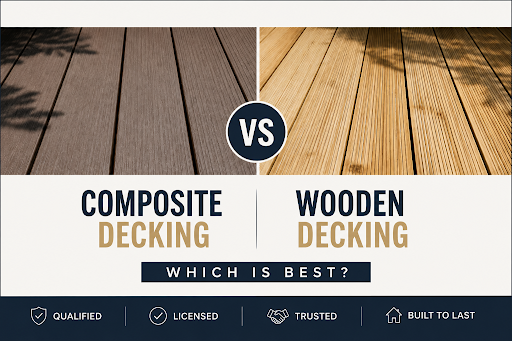
If you’re weighing up composite decking Central Coast homes are increasingly choosing against the timeless appeal of hardwood, this guide lays out the honest trade-offs. No sales spin, just how each one behaves a few hundred metres from the water.
We build decks in both materials, so we’ve watched how each ages in local conditions. Here’s what we tell homeowners when they ask which is right for them.
The Coastal Challenge: What Salt, Sun and Humidity Do to a Deck
A deck in Terrigal or Avoca lives a harder life than one out west. Salt-laden air settles on every surface. UV is relentless for much of the year. Humidity swings push timber to expand, contract and, over time, move.
Untreated or neglected timber can grey and even begin to warp within a single year near the water, and salt only speeds that wear along. Our bushfire-prone pockets add another layer to the decision too. Whatever you choose has to stand up to all of it.
That’s the lens to judge both materials through: not just how they look on day one, but how they’ll cope after five coastal summers.
Composite Decking on the Central Coast
Composite boards are engineered from recycled wood fibres and plastic, pressed into a dense, dimensionally stable board that mimics timber. The big draw is how little it asks of you once it’s down.
In coastal humidity and salt air, composite decking Central Coast installers reach for often has the edge. It doesn’t absorb moisture, won’t rot, and shrugs off salt spray and the odd pool splash. There’s no oiling and no sealing, just an occasional wash to keep it looking fresh.
The trade-offs? It costs more upfront, and darker boards can get genuinely warm underfoot in full summer sun, though lighter colours and modern heat-reducing ranges help a lot. Some people also simply prefer the authenticity of real timber to composite’s more uniform finish.
Hardwood Decking on the Central Coast
There’s a reason hardwood never really goes out of style. The depth of grain, the warmth underfoot, the way it silvers gracefully if you let it: nothing engineered quite matches it. Premium Australian timbers are also seriously tough.
When it comes to hardwood decking Central Coast homeowners have some beautiful options, and species choice matters more here than most people realise. A few local favourites:
|
Species |
Appearance |
Why it suits the coast |
|
Spotted gum |
Pale brown to chocolate, bold grain |
Tough and naturally fire-resistant — handy in BAL zones |
|
Blackbutt |
Light, golden tones |
Lighter colour suits modern coastal homes; very durable |
|
Merbau |
Rich reddish-brown |
Stable and weather-tolerant; takes oil readily |
|
Ironbark |
Deep red-brown, very dense |
Among the most durable of the Australian hardwoods |
Hardwood’s catch is upkeep. To hold that rich colour near the coast, you’ll be oiling more often than you would inland, and salt and UV are unforgiving if you skip it. Left bare, timber greys to a soft silver, which is a look you’ll either love or you won’t.
Composite vs Hardwood: A Side-by-Side Look
Here’s the quick comparison most people are after:
|
Factor |
Composite decking |
Hardwood decking |
|
Upfront cost |
Higher |
Low to moderate |
|
Ongoing maintenance |
Minimal — occasional wash |
Regular cleaning and oiling |
|
Lifespan (coastal) |
Around 25–30 years |
Decades with proper care |
|
Look & feel |
Uniform and modern |
Natural grain and warmth |
|
Salt-air resistance |
Excellent |
Good, if well maintained |
|
Heat underfoot |
Warm in sun (colour-dependent) |
Cooler, also colour-dependent |
|
Termite resistance |
Immune |
Varies by species |
|
Best suited to |
Low-fuss, busy households |
Lovers of natural timber |
Neither column is the outright winner. The right choice is the one that matches your budget, your appetite for maintenance and the look you’re chasing. If it helps to see both in the flesh, you can browse decks we’ve built in our photo gallery.
How Much Maintenance Do Composite and Wood Decks Require?
This is where the two materials part ways most clearly, so it’s worth being realistic with yourself.
Composite asks for very little: a wash down with the hose and the occasional scrub with warm soapy water. No oiling, no sanding, no sealing. Call it a weekend job once or twice a year, at most.
Hardwood is more hands-on. Near the coast, plan to clean and re-oil roughly every six to twelve months to hold the colour and protect against salt and UV. Skip it and the timber greys and dries out faster than it would further inland. Every few years it may also want a light sand before re-oiling.
Expert tip: If the thought of oiling a deck every year quietly fills you with dread, be honest about that now. The most common regret we hear isn’t about the material itself, it’s about underestimating the upkeep.
When Does Hardwood Decking Make More Sense Than Composite?
Composite gets plenty of love for good reason, but timber still wins its fair share of projects. Knowing when wood decking makes more sense than composite usually comes down to a few clear situations. Choose hardwood when:
- You want genuine, natural grain that no manufactured board can truly fake.
- Your budget favours a lower upfront cost, and you’re happy to maintain it.
- You’re in a bushfire-prone (BAL) zone where naturally fire-resistant species like spotted gum or blackbutt suit the rating.
- You love the idea of a deck that develops character and patina over the years.
- You’re matching existing timber or a heritage look elsewhere on the home.
For homeowners who genuinely enjoy looking after their outdoor space, hardwood is the heart-over-head choice, and a very good one.
Don’t Forget the Furniture: Design the Deck Around How You’ll Live
Your material choice doesn’t end at the boards. It shapes how the finished space feels once the furniture goes on it.
Composite’s consistent colour makes it easy to match with outdoor settings, rugs and planters, and because it stays splinter-free, it’s friendly for bare feet, kids and pets. Just remember that darker boards warm up in full sun, so a shaded zone or a lighter colour matters if you’ll be padding around barefoot.
Hardwood brings a natural warmth that designers love pairing with rattan, teak and linen-look furniture. Heavy furniture feet can mark any deck over time, so felt pads are a cheap, worthwhile habit on both materials.
Either way, plan the layout before you build. Where does the dining setting go? The lounge? A built-in bench your carpenter can craft in timber or clad in composite? The best outdoor living spaces are designed around furniture and flow, not just square metres. For more on getting that balance right, see our guide to creating the perfect outdoor living space.
So, Which Decking Is Right for Your Coastal Home?
If low maintenance and long-term peace of mind sit at the top of your list, composite is hard to beat by the water. If you crave natural beauty and don’t mind the upkeep, quality hardwood will reward you for years. Plenty of homeowners even mix the two: composite underfoot for ease, timber for feature screens or seating.
The honest answer is that it depends on you. A good carpenter Central Coast locals trust will walk your site, weigh up sun, salt and budget, and help you land on the right call rather than the trendiest one.
Not sure which way to lean? Our team installs both composite and hardwood across the Central Coast and will give you a straight recommendation for your block.Get in touch for a free, no-pressure quote.
Frequently Asked Questions
What is the best decking for coastal areas?
For low-maintenance durability close to the water, composite is usually the standout, since it resists salt, moisture and rot without any oiling. That said, premium hardwoods like spotted gum and ironbark perform beautifully too, as long as you’re willing to maintain them. The best choice really comes down to how much upkeep you want to take on.
What mistakes should homeowners avoid when choosing decking materials?
The big ones are choosing on upfront price alone, underestimating the maintenance, ignoring how hot dark boards get in full sun, picking a timber species that isn’t suited to coastal or bushfire conditions, and skimping on the substructure beneath good boards. Most are avoided simply by matching the material honestly to your site and lifestyle.
Is composite decking worth the extra cost?
Often, yes, especially near the coast. You pay more upfront but save on oils, sealers and weekends spent maintaining the deck, and quality composite usually carries a long warranty. Across 20 years or more, the lifetime cost frequently evens out or even favours composite.
Does composite decking get too hot in summer?
Darker composite boards can get warm in direct sun, like any dark surface. Lighter colours and modern heat-reducing ranges help, and a pergola or shade sail makes a big difference. For a deck in constant full sun where you’ll be barefoot, factor heat into your colour choice from the start.
How long does decking last near the coast?
Quality composite typically lasts around 25 to 30 years and often carries a lengthy warranty. Durable hardwoods can last decades too with regular maintenance, though salt and UV will shorten that if upkeep slips. A sound substructure and proper installation matter as much as the boards themselves.
Can you mix composite and hardwood on one deck?
You can, and plenty of homeowners do. A popular approach is composite for the main floor with timber for feature elements like bench seating, screens or a framed border. A skilled carpenter can blend the two so they complement each other rather than clash.
Build Once, Build Right
Composite and hardwood are both excellent decking choices; they simply suit different people. Composite trades a higher starting price for easy years ahead, while hardwood trades upkeep for natural beauty that’s hard to replicate. On the coast, the smartest move is to be honest about how much maintenance you’ll realistically do, then choose accordingly.
Whichever way you lean, the quality of the build matters as much as the material. Get both right and you’ll have a deck that handles every salty summer the Central Coast can throw at it.
Ready to start your deck? With 30 years of combined experience in both composite and hardwood, Central Coast Elite Carpentry will help you choose well and build it to last. Contact us today for your free quote.